Last Updated on December 9, 2025 by foxintheforest
The first time I heard about Cathedral Valley, Utah, I was intrigued. A 58-mile dirt road loop through one of the most remote sections of Capitol Reef National Park? Sign. Me. Up!
It took me a few years, but eventually I drove the Cathedral Valley Loop in a stock 4Runner with my 3-year-old daughter, and it was one of the most spectacular day trips we’ve done in southern Utah.
The road was bumpy for sure. But it wasn’t technical. It wasn’t scary if you’re comfortable driving on dirt. And the landscapes we encountered felt like we’d driven onto another planet.
If you’re considering the Cathedral Valley Loop but feeling intimidated by the warnings and vehicle requirements, this guide is for you. I’m breaking down exactly what to expect, how to prepare, and why this remote corner of Capitol Reef deserves a spot on your Utah itinerary.
Cathedral Valley at a Glance
Location: Northern section of Capitol Reef National Park, Utah
Total Distance: 58 miles (loop), approximately 60-ish miles with side trips.
Time Needed: 6-8 hours with stops (we completed it in 6.5 hours)
Vehicle Requirements: High-clearance vehicle recommended (4WD helpful, AWD required)
Best Seasons: March through May, September through November
Entry Fee: $20 for US citizens or free with an America the Beautiful Pass
Cell Service: None. Bringing a sattelite communicator is highly recommended.
Difficulty: Moderate (bumpy road, not technical driving)
Must-See Stops:
- Temple of the Sun and Moon
- Bentonite Hills
- Upper Cathedral Valley Overlook
- Upper South Desert Overlook
Starting Point: Hartnet Road entrance (clockwise direction recommended)

What Makes Cathedral Valley, Utah So Special?
Utah’s Best-Kept Secret
While thousands of visitors flock to Capitol Reef’s scenic drive and popular trails each year, fewer than 1% venture into Cathedral Valley. This means you’ll experience the kind of solitude that’s increasingly rare in Utah’s national parks.
We didn’t see a soul until halfway through our drive. Solitude was found at pristine overlooks, small hiking trails, and open road.
But solitude isn’t the only draw. Cathedral Valley Capitol Reef showcases geology you won’t find elsewhere in southern Utah. Instead of the typical Navajo sandstone fins and domes, you’ll encounter massive monoliths rising from the valley floor, volcanic clay hills striped in purples and grays, and expansive desert vistas that stretch to distant mountain ranges.
The landscape looks like a giant was making sand castles.
The Temple of the Sun and Moon formations are genuinely jaw-dropping. These 500-foot sandstone towers stand isolated in the desert, their sheer walls glowing orange and pink in the right light. You can hike right up to them, which really gives you a sense of the enormity of these monoliths.
The Bentonite Hills look like someone melted a box of crayons across the landscape. Colors meld into a series of mesmerizing hills.
And the overlooks provide perspectives that make you feel incredibly small in the best possible way.
Why Families (Even With Toddlers) Can Tackle This
I know what you’re thinking: a 6-hour dirt road adventure with a 3-year-old sounds like a recipe for disaster. But here’s why it worked for us.
The driving portions break up naturally with viewpoints and photo stops every 30-45 minutes. My daughter got to explore at each stop, climbing on rocks and collecting “treasures.” (Yes, we left them there at the end of our journey).
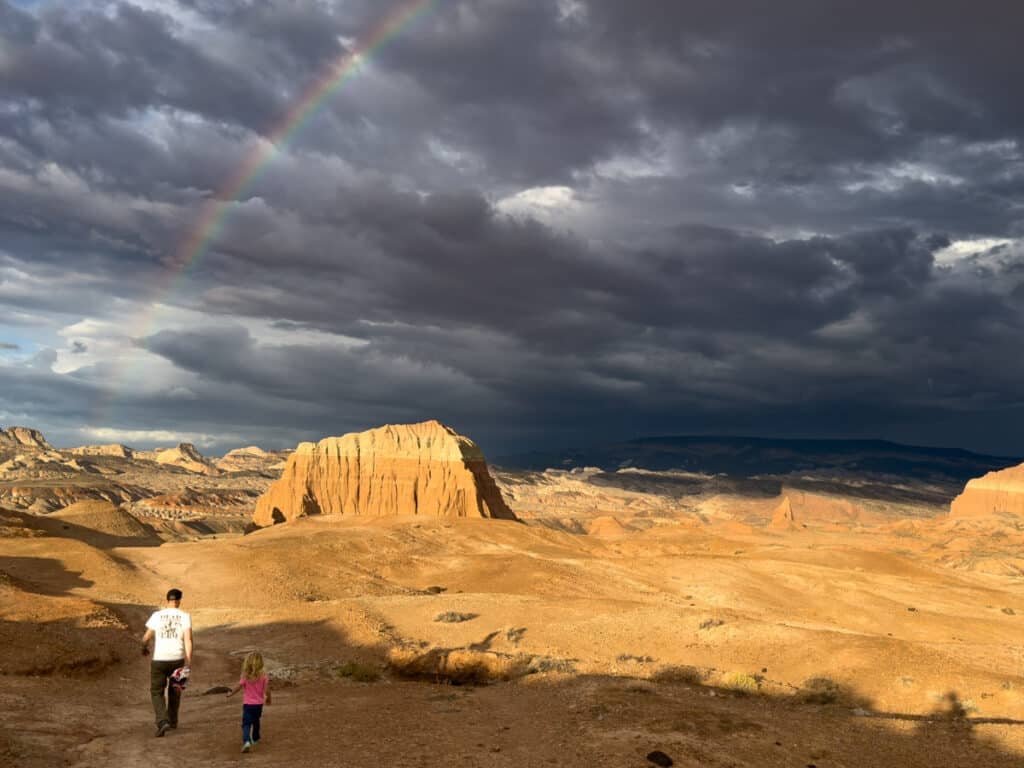
We brough a pair of binonculars for her to use and plenty of snacks to nudge her along on hikes. There were rainbows in the distance. Big ridges to hike up for a view. And plenty of chances to play in the dirt.
The bumpy sections actually entertained her more than smooth highway driving. And teaching her about the landscape, flora, and fauna turned the drive into an ongoing conversation rather than just car time.
She’s been a desert road trip warrior since she was born, which certainly helps.
Pro Tip: The key is preparation. We packed plenty of snacks, downloaded kids’ music for the bumpy sections, and framed the adventure as exploring a special place few people get to see. She still talks about “driving through the river” months later.

Planning Your Cathedral Valley Loop Adventure
When to Visit Cathedral Valley Utah
Best Months: April through May and September through November offer the ideal combination of moderate temperatures and lower precipitation risk.
Safety Note: Spring runoff can make the water flows too high for the river crossing. Take extra care in spring.
Summer (June-August): Possible but brutally hot. Temperatures regularly exceed 100°F with zero shade along the route. Pesky monsoon rains can easily trap for days you along the road, especially bentonite secions, so check the weather before haeding out. If you go in summer, start at sunrise and bring twice as much water as you think you need.
Winter (December-February): The road can become impassable with snow and ice. Check conditions before attempting winter visits.
Spring and Fall: These shoulder seasons deliver comfortable temperatures, beautiful light, and the lowest chance of afternoon thunderstorms that can make roads impassable.
I visited in early October, and conditions were almost perfect.
We were tempting fate with rain in the forecast that evening, but we were camping so we had plenty of supplies should something happen. Temperatures were in the 70s, the rain behaved and showed up late, and we only saw a handful of other vehicles the entire day.
However, it rained the following day in Capitol Reef and we saw first hand how quickly desert washes fill and rivers can form without warning. With ample desert experience, we were in a safe location, but just know that you should be very aware of the forecast before heading out.
Weather and Road Conditions
This is crucial: Cathedral Valley Loop roads become completely impassable when wet. The Bentonite Hills section turns into slick clay that even the most capable 4×4 vehicles cannot navigate. Flash floods can wash out sections of road with little warning.
Before you go:
- Check the 7-day forecast for the area
- Call 435-425-3791 (ranger station) for current road conditions
- Ask about the Fremont River crossing water level
- If there’s any rain in the forecast, reschedule your trip
I cannot stress this enough: do not attempt Cathedral Valley if rain is expected or if it has rained recently. The consequences range from getting stuck for hours to damaging your vehicle to putting yourself in genuine danger. Not to mention, a tow to get out will run you a minimum of $2,000.
Vehicle Requirements: The Real Story
Every guide about Cathedral Valley emphasizes that you need a high-clearance 4×4 vehicle. And while high clearance is definitely important, I want to give you the nuanced reality.
What Worked for Us:
- Stock Toyota 4Runner (no lift kit)
- BF Goodrich All-Terrain tires
- AWD capability (we never needed to engage 4WD, but would consider it a must-have for this road)
- About 9 inches of ground clearance
Where Clearance Matters:
- The Fremont River crossing (rocks on the riverbed, water levels)
- Rocky sections where the road is very uneven, particularly near the campground.
- The steep climb/descent near Cathedral Valley Campground
- A few wash crossings that are a little stee
Where 4WD Would Help:
- Steeper sections when traction is reduced
- If you encounter any mud or wet conditions
- TONS of very severe washboard. Sometimes having 4WD activated can avoid you feeling like you’re “floating.”
- Any washes that may have lingering water
The Bottom Line: A stock 4Runner or equivelent is the minimum recommendation for this drive. A sedan or low-clearance vehicle cannot. True 4WD provides an extra margin of safety but we never engaged 4WD on our trip. This doesn’t mean you shouldn’t have it – you absolutely should. But this is not a Jeep trail by any means.
Don’t Have the Right Vehicle?
- Rent a high-clearance SUV or Jeep in Torrey or Hanksville
- Join a guided tour (several companies offer Cathedral Valley tours)
- Skip the full loop and do just the Temple of the Sun and Moon section, which has the best road conditions and avoids the river crossing as well as the large, rutted hill.

Essential Preparations
Fuel: Fill up completely in Torrey or Hanksville. There are no services anywhere on the loop, and you’ll be driving 65+ miles in low gear on rough roads, which burns more fuel than highway driving.
Water and Food: Bring at least one gallon of water per person, plus snacks or a packed lunch. We made sandwiches and brought a cooler, which meant we could take our time and not rush back to town hungry.
Navigation: Cell service is nonexistent on the Cathedral Valley Loop. Download offline maps before you leave. Better yet, stop at the Capitol Reef Visitor Center and pick up a paper map of Cathedral Valley that shows all the stops and mileage.
Emergency Supplies:
- Full-size spare tire (check it before you go)
- Basic tools
- First aid kit
- Flashlight or headlamp
- Extra layers (temperature swings can be significant)
- A way to sleep at night
- Sattelite communication device
Timing: I recommend starting early. We hit the road at 6:30 AM and finished around 1:00 PM. This gave us beautiful morning light, cooler temperatures, and plenty of time buffer if anything went wrong.
Cathedral Valley Loop: The Complete Driving Guide
Which Direction Should You Drive?
After completing the loop, I strongly recommend driving clockwise, starting at the Hartnet Road entrance and ending at Caineville Wash Road. Here’s why this direction works better:
River Crossing First: You’ll know within the first 15 minutes whether you can complete the loop. If the Fremont River is too high or you’re uncomfortable with the crossing, you can turn back without losing hours of driving.
Logical Ending: You’ll finish the loop closest to Hanksville, which means you can stop for a cold drink or ice cream after a dusty day in the desert. Trust me, this feels amazing after 6 hours on dirt roads.
Easier Campground Access: If you’re camping at Cathedral Valley Campground, you reach it before the steepest, most technical section of road.

Finding the Clockwise Starting Point (Hartnet Road)
From the Capitol Reef Visitor Center, drive east on Highway 24 for approximately 11.7 miles. You’ll see a sign on your left for “Hartnet Road / Cathedral Valley / River Ford.”
Turn left here. The paved road quickly becomes dirt. Stay right at the fork about 0.3 miles in (the left fork dead-ends at a steep drop-off to the river).
You’ll reach the Fremont River crossing about 1 mile from Highway 24.
The Fremont River Crossing
This is the moment that gives everyone pause. The Cathedral Valley Loop requires you to drive through the Fremont River. There is no bridge.
What to Expect:
- The river is typically 6-12 inches deep in normal conditions
- The bottom is packed gravel and rock (not mud)
- You’ll drive diagonally across, not straight over
- The current is usually gentle
- The crossing is about 50-60 feet wide
How We Crossed:
- Stopped at the river’s edge and got out to scout
- Identified the crossing route (look for tire tracks)
- Put the vehicle in low gear
- Drove slowly but steadily across (don’t stop in the middle)
- Emerged on the other side with wet tires but totally fine
The crossing took maybe 30 seconds. Our 4Runner had zero issues. The water never came close to the door seals.
When NOT to Cross:
- If the water appears muddy or fast-moving
- If you can’t see the bottom clearly
- If the water level looks higher than 12 inches
- If you’re uncomfortable after scouting it
Remember, you can always call 435-425-3791 for current river conditions before you leave.
After the crossing, the road climbs slightly and then flattens into the first section of beautiful desert landscape.
Stop-by-Stop: The Best of Cathedral Valley Capitol Reef
1. Abandoned Well Drilling Equipment (Mile 7.2)
What It Is: An old colorful truck and drilling equipment rusting in the red sand.
Time Needed: 10 minutes
Our Experience: This roadside photo op is quirky and fun. The contrast of the rusted truck against white sand and colorful Bentonite Hills makes for great pictures. We snapped a few photos, answered a lot of toddler questions and moved on.

2. Bentonite Hills (Mile 8.7)
What It Is: Hills of volcanic clay sediment striped in purples, grays, blues, and oranges that look legitimately alien.
Time Needed: 30-45 minutes
Our Experience: The Bentonite Hills at sunrise was one of the biggest surprises of the Cathedral Valley Loop. You’ll drive through several miles of these formations, and they just get more dramatic as you go.
The clay is soft and crumbly when dry, which is why this section becomes completely impassable when wet. There is a small pullout at mile 8.95 with a social trail for an upclose look. Just be aware that the trail is loose.
My daughter loved the “purple mountains” and kept pointing out different colors. It’s a genuinely fun landscape for kids because it looks so fantastical. I felt like I was on the moon.
This is a great photo stop regardless of the time of day. Mid-day brightens the colors up, but the florescent colors of sunrise made for a dramatic scene.
Important: This is where Cathedral Valley becomes most dangerous in wet conditions. If you see dark clouds, leave immediately.
3. Major Junction (Mile 10.3)
Stay left on the main road to continue along the Cathedral Valley Loop.
4. Lower South Desert Overlook (Mile 14)
What It Is: A short walk to a dramatic overlook of the South Desert with views of Jailhouse Rock and Temple Rock in the distance.
Take the side road (labeled). It’s about 1.1 miles each way. You can hike the old road from the parking area for even more dramatic viewpoint.
Time Needed: 20-30 minutes
Our Experience: After parking, we walked about 0.25 miles to a rocky promontory. The view opens up to reveal an enormous expanse of desert punctuated by distant rock formations. The sense of scale is overwhelming. You can see for probably 30 miles in some directions.
This is a good spot for a snack break. We sat on the rocks, watched a rainbow, and marveled at the landscape.
Trail Note: The walk is easy and family-friendly. The “overlook” isn’t marked with a sign – you’ll know you’re there when you reach a shelf with a dramatic drop-off.
You can continue along the trail and descend into the Lower South Desert. It’s around a 4.6 round-trip hike.
5. Temple of the Sun and Moon Overlook Trail (Mile 17.5)
What It Is: A short, sandy hike up to a ridge for a top-down look at the main rock spires of Cathedral Valley
Time Needed: 45 mins to an hour
Our Experience: We had a tough time following the braided social trail on the way out and did quite a bit of sand hiking. But on the back, it was pretty obvious where we should have gone (we missed the proper trail crossing a dry riverbed).
It’s about a 1.5-mile hike and relatively simple, with a short, steep section at the end.
6. Upper South Desert Overlook (Mile 27.1)
What It Is: A short spur road to a short hike with a nice overlook.
Time Needed: 10 minutes
Our Experience: We stopped here and got a sliver of cell service (T-Mobile). We used this as an opportunity to spot-check weather while our daughter used her binoculars to look for birds and dinosaurs.
7. Major Junction #2 (Mile 28.1)
This is the point of no return. If the weather is dry and there is no snow, turning left will climb straight up and over Thousand Lake Mountain to Highway 72.
Staying right continues along the Cathedral Valley Loop.
8. Cathedral Valley Campground (Mile 28.4)
What It Is: A primitive campground with six sites, picnic tables, fire rings, and a pit toilet.
Time Needed: 0-5 minutes (unless you’re camping)
Our Experience: We didn’t stop here, but it is a juniper-filled campground on a high point along the road.
The campground looked nice for primitive camping. Each site has a table and fire ring with good spacing between sites. If you’re into camping and have stable weather, this would be an incredible place to spend a night.
Camping Details:
- Free (first-come, first-served)
- Six sites
- Vault toilet
- No water
- Fire rings and picnic tables
- Absolutely stunning dark skies for stargazing
Just past the campground, the road gets noticeably steeper. If it’s muddy, turn around. The next section of road has steep drops and rough terrain.
9. Cathedral Trails (Mile 30.5)
What It Is: A 3-mile round-trip hike giving you up-close views of the rock cathedrals. There’s a little bit of uphill to start, but this is a lovely trail.
Time Needed: 1.5 hours
Our Experience: We did a little over a mile of this trail. We stopped for a snack and enjoyed the views, which start just after you surmount the hill at the start.

10. Gypsum Sinkhole (Mile 33.4)
What It Is: A 200-foot-deep sinkhole formed when groundwater dissolved a buried gypsum plug, causing the ground above to collapse.
Time Needed: 10-15 minutes
Our Experience: Park along the road and walk about 100 yards to the sinkhole’s edge. We didn’t get out – our daughter was napping. But I imagine it is very eerie. Be aware of the edge especially if you’re with kids.
Safety Note: Stay away from the edge. The ground can be unstable, especially after rain.
11. Glass Mountain (Mile 42.8)
What It Is: A mound of selenite crystals that shimmer in the sunlight like glass shards.
Time Needed: 10-15 minutes
Our Experience: This is a quick roadside stop. You’ll see the white, sparkling mound on your right. We pulled over and let our daughter examine the crystals The “mountain” is relatively small, maybe 15 feet tall, and we found it to be pretty unimpressive.
3. Temple of the Sun and Moon (Mile 42.8)
What It Is: The crown jewel of Cathedral Valley, Utah. Three massive sandstone monoliths rising 500+ feet from the valley floor.
Time Needed: 30-45 minutes minimum (you’ll want longer)
Our Experience: This is where the Cathedral Valley Loop justifies every bumpy mile. These formations are staggering in person. This was one of our favorite spots
The Temple of the Sun is the largest and most impressive, with sheer vertical walls that glow brilliant orange in morning light. The Temple of the Moon sits nearby, slightly smaller but equally striking. A third, smaller formation completes the cluster.
The dirt road loops around all three formations, giving you different perspectives. However, I highly recommend getting out and circling around one or both of the Temples. They are so impressive.
We chose to hike right up to the base – which was a bit of a pain, but our daughter loved sliding down and getting dirty.
Photography Tips:
- Morning light (7-10 AM) paints the temples in warm orange tones
- Shoot from the northwest side for the classic composition showing all three formations
- Include a person for scale – it really emphasizes how massive these are (can you spot us in the photos)
- Midday harsh light actually works well here, emphasizing the texture and scale
Why This Stop Matters: If you only have time or energy for one stop on the Cathedral Valley Loop, make it this one. These formations are the reason most people make this journey.

10. The Final Stretch (Miles 42.3-58.1)
Buhhhhhhh so. Much. Washboard.
The last 10 miles are probably the roughest in terms of washboard surface. We got utterly rattled. A bolt backed out of one of our control arms that we later had to fix.
It was largely uneventful and a bumpy way to end such an amazing day.
You’ll pop out on Caineville Wash Road, which leads directly to Highway 24. Turn left on Highway 24 to reach Hanksville in about 10 minutes.
Post-Loop Reward: Stop at Blondie’s Eatery in Hanksville for ice cream or a cold drink. After 6 hours of dust and bumps, it tastes like the best thing you’ve ever had.
Doing Cathedral Valley With a Toddler: Practical Tips
Driving Cathedral Valley with a toddler was a pretty straightforward endeavor for us. However, we’ve taken her to the Maze in Canyonlands and even Toroweep Overlook in the Grand Canyon. If you’re new to bumping down the dirt with a little in tow, here are a few quick tips.
Timing Breaks Strategically: We stopped every 45-60 minutes, which aligned naturally with the viewpoints. At each stop, we let her run around, climb on rocks (safely), and explore. This released energy and kept her engaged.
Snacks Are Everything: I packed way more snacks than I thought we’d need. And I was thankful for it Having a constant supply of interesting snacks kept crankiness at bay.
Entertainment for Bumpy Sections: Downloaded music she loves, audiobooks, and had some small toys within reach. The bumpy sections actually entertained her – she thought it was hilarious.
Make It an Adventure: We framed the whole trip as a special exploration to places most people never see. She got to be part of something cool, and that made her invested in the experience.
Sun Protection: Hat, sunscreen, and long sleeves for stops. The sun is intense, even in fall.
Realistic Expectations: We didn’t try to do every single stop or hike every trail. We prioritized the big-ticket items and stayed flexible.
Take Breaks: We got out of the car a lot. Potty breaks, views, hikes, and even just running our sillies out. Budget some extra time.

Essential Logistics for Cathedral Valley Utah
Getting There
From Salt Lake City: 3.5 hours (220 miles) via I-15 S and US-50 E/US-6 E
From Moab: 2.5 hours (145 miles) via UT-191 S and UT-24 W
From Capitol Reef Visitor Center: 30 minutes (20 miles) via UT-24 E to Hartnet Road
From Hanksville: 15 minutes (11 miles) via UT-24 W to Hartnet Road
Nearest Major Airport: Salt Lake City International (SLC)
Where to Stay
Torrey (40 minutes from Cathedral Valley start):
- Closer to main Capitol Reef attractions
- More dining and lodging options
- Our base for the trip
- Good choice if you’re exploring Capitol Reef comprehensively
Hanksville (15 minutes from Cathedral Valley start):
- Closest town to Cathedral Valley Loop
- Fewer amenities but perfectly adequate
- Better choice if Cathedral Valley is your primary focus
- Convenient ice cream stop after the loop!
Inside the Park:
- Cathedral Valley Campground (primitive, free)
- Fruita Campground (developed, near visitor center)
We BLM camped off-grid along South Notom Road. That was our home base for exploring Capitol Reef National Park on this trip and it worked out well.
Park Entry and Regulations
Entrance Fee: Cathedral Valley Capitol Reef is part of Capitol Reef National Park. You’ll need either:
- Capitol Reef day pass ($20 per vehicle) US citizens
- America the Beautiful Annual Pass ($80)
- Free with military/senior passes
Important Rules:
- Pack out all trash (Leave No Trace)
- No dispersed camping inside the national park (use designated campground or you can find a few dispersed sites at the start of the road – use OnX OffRoad for Forest Service Boundary)
- No camping in vehicles along the road
- Dogs are not allowed
- Stay on designated roads
- No collecting rocks, plants, or artifacts
Emergency Contact: 435-425-3791 (this is also the number for road conditions)
What to Bring: Complete Checklist
Vehicle Essentials:
- Full tank of gas
- Full-size spare tire (checked and inflated)
- Basic tools
- Jack and lug wrench
- Tire repair kit
- Jumper cables
Navigation:
- Offline maps downloaded
- Paper map from visitor center
- Compass or GPS device
- This guide (printed or saved offline)
Safety and Comfort:
- 1+ gallon water per person per day
- Extra water for vehicle
- First aid kit
- Sunscreen (SPF 30+)
- Hat and sunglasses
- Sunshirt
- Layers (temperature swings)
- Flashlight or headlamp
- Emergency blanket
- Matches or lighter
- Emergency layers, consider packing a sleeping bag for each person
- Sattelite communication deivce
Food:
- Packed lunch
- Snacks
- Cooler with ice
For Kids:
- Extra snacks (seriously, extra)
- Entertainment (downloaded music, books, toys)
- Sun protection
- Wet wipes
- Plastic bags (for trash and potential, car sickness, or packing out a number 2)
Photography:
- Camera with charged batteries
- Extra memory cards
- Lens cleaning supplies
- Tripod (for overlook shots)
- Phone charger
Is Cathedral Valley Worth It? My Honest Assessment
After driving the Cathedral Valley Loop, I can say without hesitation: yes, it’s worth it. I wouldn’t mind doing it again and spending the night at the campground.
But let me be more specific about who should go and who might want to skip it.

You Should Absolutely Do Cathedral Valley If:
You Want Solitude: We saw less than 5 other vehicles in 6 hours. This is genuine wilderness experience without backcountry camping.
You’re a Photography Enthusiast: The landscapes are utterly unique. You won’t get these shots anywhere else.
You Want Your Kids to Experience Real Adventure: This is the kind of trip kids remember forever. It’s challenging enough to feel like an accomplishment but doable enough to be fun rather than miserable.
You’re Comfortable with Dirt Roads: If you’ve driven forest service roads or similar routes, this won’t intimidate you.
You Have the Right Vehicle: High clearance makes this dramatically easier and more enjoyable.
You Should Skip Cathedral Valley If:
You Have Very Limited Time in Capitol Reef: If you only have one day in the park, spend it on the scenic drive, Hickman Bridge, Cassidy Arch, and other developed areas. Cathedral Valley requires a full day.
You’re Uncomfortable with Remote Driving: If the idea of being an hour from help on a dirt road makes you genuinely anxious, this won’t be fun for you.
You Don’t Have Appropriate Vehicle Access: Don’t risk it in a low-clearance car. Rent something appropriate or join a tour.
Weather Is Questionable: If there’s any rain in the forecast, it’s not worth the risk.
The Bottom Line
Cathedral Valley in Utah offers something increasingly rare in our national parks: a true sense of discovery. You’re not following crowds to Instagram-famous viewpoints. You’re not timing your visit to avoid other tourists. You’re genuinely exploring a landscape that most people never see.
The Temple of the Sun and Moon are as impressive as any formation in Utah’s famous parks. The Bentonite Hills are completely unique. The overlooks provide a perspective that makes you feel properly small in the universe.
Yes, the road is bumpy. Yes, it takes a full day. Yes, you need to prepare and plan carefully.
But if you’re looking for the kind of adventure that reminds you why you travel, why you seek out wild places, why Utah’s landscapes inspire people to cross continents to see them – Cathedral Valley delivers that in spades.
Frequently Asked Questions About Cathedral Valley Loop
Can you do Cathedral Valley without 4WD?
No. You need high clearance (8+ inches minimum) and AWD or 4WD capability. You just may not use it. A stock 4Runner or similar SUV with AWD can handle the route in good conditions if driven carefully. We never had our vehicle in 4WD but we had great road conditions. However, true 4WD provides an extra margin of safety. Do not attempt this in a sedan or low-clearance crossover.
How long does the Cathedral Valley Loop take?
Plan for 6-8 hours total. The driving itself takes about 4 hours at the necessary slow speeds (10-15 mph on rough sections, 20-25 mph on better sections). Add 2-4 hours for stops, photos, and short walks to overlooks. We completed it in 6.5 hours with a toddler, stopping at all major viewpoints.
Is Cathedral Valley safe for kids?
Yes, with proper preparation. The drive itself is safe if you go slowly and carefully. Kids need to be supervised closely at overlooks (sheer drop-offs). Bring plenty of water, snacks, sun protection, and entertainment. Make sure you have emergency supplies. Be prepared to spend the night in case something happens. We did it with a 3-year-old and she loved it.
When is the best time to visit Cathedral Valley?
April through May and September through November offer ideal conditions. Summer (June-August) is extremely hot but possible with early starts. Winter can bring snow and ice that make the road impassable. Always check current conditions before going.
Pro Tip: Spring runoff can make the river crossing impossible; fall is preferred.
Can you camp in Cathedral Valley?
Yes, at Cathedral Valley Campground only. It’s a free, primitive campground with six sites located roughly halfway through the loop. Each site has a picnic table and fire ring. There’s a vault toilet but no water. First-come, first-served. No dispersed camping is allowed elsewhere within the national park boundary.
What’s the river crossing like?
The Fremont River crossing is typically 6-12 inches deep with a packed gravel bottom. You drive diagonally across about 50-60 feet. In normal conditions, it’s straightforward for high-clearance vehicles. Check water levels by calling 435-425-3791 before you go. Do not attempt during high water or flooding conditions.
Do you need a permit for Cathedral Valley?
No special permit is required, but you do need a valid Capitol Reef National Park entrance pass. This can be a day pass ($20 per vehicle) or an America the Beautiful Annual Pass ($80). Show your pass if stopped by rangers.
Is there cell service in Cathedral Valley?
No. There is zero cell service throughout the entire loop. We got lucky with a couple bars at one overlook in a particular spot with T-Mobile, but that’s a far cry from being reliable. Download offline maps, tell someone your plans, and bring emergency supplies. The only contact option is emergency satellite devices.
Can you drive Cathedral Valley in a rental car?
Yes, but you must rent an appropriate vehicle. A standard rental sedan or compact SUV will not work. Rent a high-clearance SUV like a 4Runner, Jeep Grand Cherokee, or similar. Check your rental agreement – some companies prohibit off-pavement driving.
What is the best stop on Cathedral Valley Loop?
The Temple of the Sun and Moon is universally considered the highlight. We also loved If you only have time for one stop, make it this one. The Temple of the Sun and Moon Overlook and Upper Cathedral Valley Overlook are our close seconds. All three are absolutely worth your time.
More Capitol Reef Adventures
Cathedral Valley, Capitol Reef is just one piece of this incredible national park. Don’t miss:
- Scenic Drive: Paved 8-mile route through classic Capitol Reef landscapes
- Hickman Bridge: Easy 2-mile hike to a stunning natural bridge
- Capitol Gorge: Narrow canyon with pioneer history
- Cassidy Arch: Moderate hike with big payoff views
- Fruita Historic District: Orchards, historic buildings, and fresh pies
Final Thoughts: Why Cathedral Valley Matters
In an era when Utah’s famous national parks are loved nearly to death, when you have to win lotteries for permits and arrive at sunrise to find parking, Cathedral Valley feels like a gift.
It’s accessible enough that families can do it. Remote enough that you’ll have it mostly to yourself. Beautiful enough to justify every bumpy mile.
My daughter will probably forget the details as she grows up. But I hope she remembers the feeling – that sense of being somewhere special, somewhere wild, somewhere that required a little courage and effort to reach. Those are the experiences that shape how we see the world.
If you’re planning a Utah adventure and you have one spare day, the right vehicle, and the right weather conditions, you’re in for a real adventure.